Could two identical school instruments have different depreciation estimates? Yes. Their expected useful lives, residual values or maintenance histories may differ. A depreciation calculator for school instruments can make the arithmetic straightforward, but its result is only as useful as the details and assumptions entered.
If you’re responsible for a school or music service’s assets, it can be difficult to choose consistent assumptions when records are scattered across spreadsheets, invoices and maintenance notes. This guide explains a repeatable way to estimate depreciation, what the figure can and can’t tell you, and how to keep the reasoning traceable. An accounting estimate isn’t the same as tax treatment, so keep that distinction clear when using the result.
You’ll learn what information to gather, how useful life and residual value affect a calculation, and when to review assumptions as an instrument moves through its instrument lifecycle. Organised asset details and maintenance history make those reviews easier to manage. Xperios Instrument Management supports instrument asset administration and maintenance history. It doesn’t calculate depreciation, but it can help keep relevant information together.
Key Takeaways
- A depreciation calculator for school instruments estimates depreciation from the information entered. It does not assess an instrument’s physical condition.
- Use a consistent sequence: record the acquisition amount, estimate residual value, set useful life and select a calculation method.
- Compare straight-line and reducing-balance methods by how they allocate depreciation over time, then apply your chosen approach consistently.
- Schedule reviews and update instrument status so assumptions remain relevant as an instrument moves through its lifecycle.
- Keep accounting depreciation separate from tax calculations, and maintain clear records to support your organisation’s financial reporting.
Table of Contents
- What a depreciation calculator for school instruments can, and cannot, tell you
- How to calculate school instrument depreciation using clear inputs
- Straight-line or reducing-balance depreciation: choosing a suitable estimate
- Keep depreciation estimates useful with an instrument lifecycle record
- Manage instrument records with Xperios, then take a clear next step
What a depreciation calculator for school instruments can, and cannot, tell you
A depreciation calculator for school instruments can help estimate how an asset’s recorded value is allocated over time. For a school instrument, depreciation is the allocation of its recorded cost across its estimated useful life. The calculation can support planning, but it depends on the information and assumptions you provide. It can’t inspect an instrument, confirm its condition or determine whether your organisation’s accounting policy has been applied correctly.
For example, enter an acquisition amount, an estimated residual value and a useful life, and a calculator can apply a selected method to produce an estimate. Change any of those inputs and the result may change. Treat the figure as a working estimate, not an independent valuation. For a general introduction to the concept and common methods, see Depreciation (accounting).
Be clear about the purpose of the estimate. An internal figure may help you review an instrument’s recorded value and plan for future asset needs. Formal financial reporting must follow the accounting approach and policies that apply to your organisation. Tax treatment is a separate matter, so don’t use a calculator result alone to prepare a tax return or decide what can be claimed. If you’re unsure how the rules apply, seek advice from a qualified accounting professional.
Which school instruments might an estimate cover?
You might estimate depreciation for instruments held for pupil loan or used to provide teaching, such as a school-owned violin, trumpet or keyboard. Whether an item is treated as a depreciable asset depends on your organisation’s accounting policy and the item’s circumstances. Don’t assume every purchase is treated alike. Consumables, such as items intended to be used up or replaced regularly, may be accounted for differently. A general calculator can’t apply one universal rule to every school.
Give each instrument its own asset record and assumptions. Record identifying details alongside the information used for the estimate, so you can distinguish similar instruments and explain how each figure was reached. This is especially useful when instruments are loaned to pupils, moved between teaching settings or returned for maintenance. An average estimate for an entire instrument group can hide differences in acquisition date, expected use and recorded value.
What a calculator result does not establish
A calculated book value is not necessarily the amount an instrument could be sold for. It follows the method and assumptions entered; it doesn’t establish current demand, resale condition or a market price. Depreciation also doesn’t tell you whether an instrument is playable, safe to issue or in need of repair. Those questions require suitable condition and maintenance checks.
Use the result as one part of a wider review, alongside the instrument’s records and status. If the instrument has been repaired, damaged or put to a different use, record that information for consideration under your organisation’s accounting process. A maintenance event may prompt a review, but it doesn’t automatically change the accounting value. A calculator can handle the arithmetic; it can’t replace professional accounting advice or your organisation’s documented judgement.
How to calculate school instrument depreciation using clear inputs
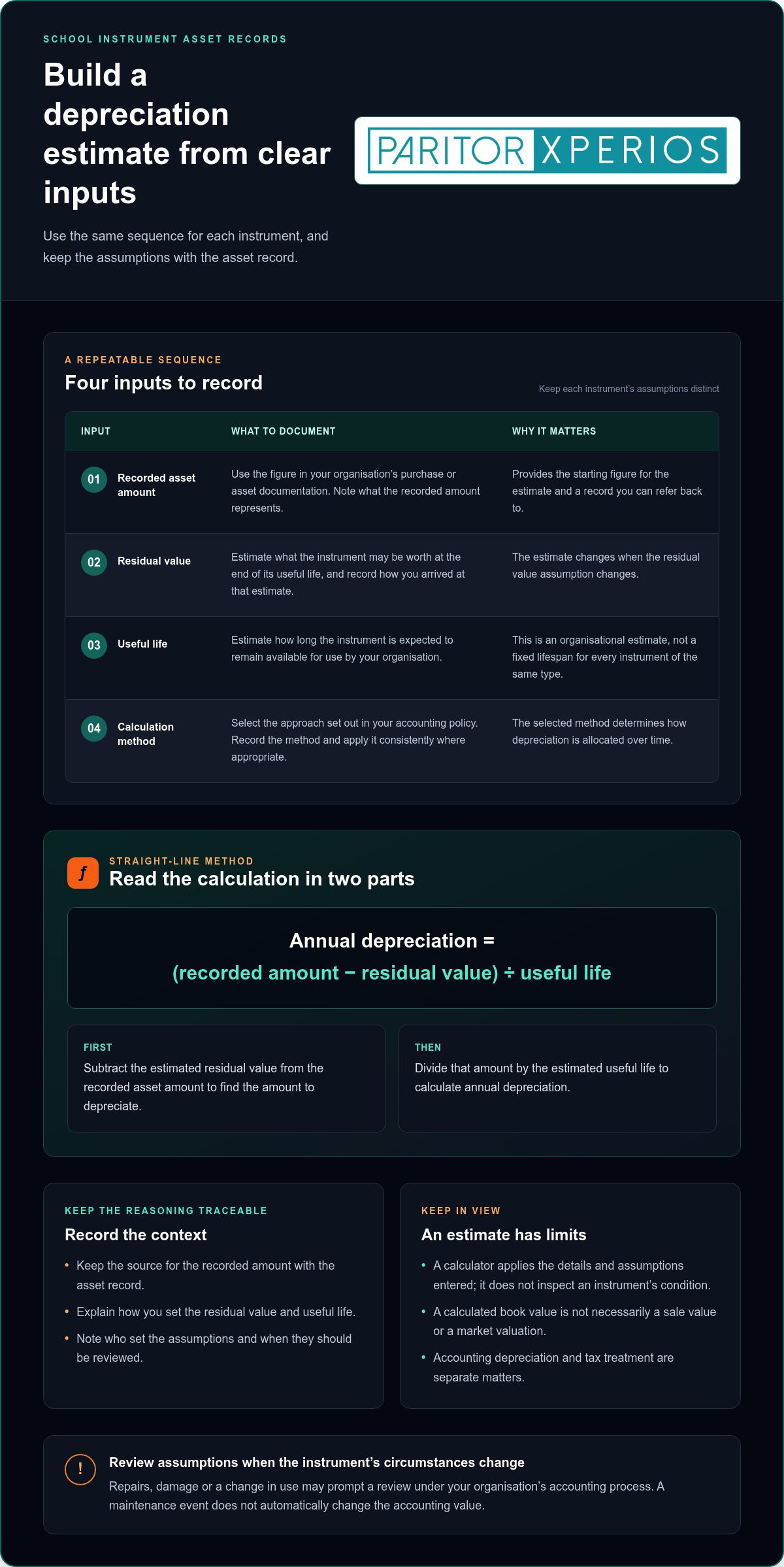
A useful estimate starts with a consistent record, not a guess copied from another instrument. Follow the same sequence for each asset, then keep the inputs and reasoning together for future review. A depreciation calculator for school instruments can do the arithmetic, but your organisation still needs to set and document the assumptions.
- Record the original asset cost. Use your organisation’s purchase or asset documentation, and note what the recorded figure represents.
- Estimate the residual value. This is the amount you expect the instrument to be worth at the end of its estimated useful life.
- Set the useful life. Estimate how long the instrument is expected to remain available for use by your organisation.
- Choose the method. Follow the approach in your accounting policy and apply it consistently where appropriate.
Choose and document the calculation inputs
Note the source for the recorded cost, such as the relevant purchase or asset record. Explain how you arrived at the residual value and useful life, rather than recording only the final figures. Useful life is an estimate for your organisation, not a fixed lifespan for every instrument of the same type. Record who set the assumptions and when they should be reviewed.
Read a straight-line calculation step by step
Straight-line annual depreciation equals (cost minus residual value) divided by useful life, where cost is the recorded asset amount, residual value is the estimated amount at the end, and useful life is the estimated number of years. First subtract the residual value from the recorded amount to find the depreciable amount. Then divide that amount by the useful life to estimate the annual depreciation.
Hypothetical example: Suppose an organisation records an instrument amount of 100 calculation units, estimates a residual value of 10 units and sets a useful life of five years. The depreciable amount is 90 units. Dividing 90 by five gives an annual straight-line estimate of 18 units. These units demonstrate the arithmetic only. They are not a monetary valuation or a recommended lifespan.
Use a consistent level of precision throughout the calculation. If your records show whole units, round the annual estimate consistently and note how you rounded it. Don’t change the inputs to produce a preferred result. If a documented assumption changes after review, retain the reason and date so the revised estimate can be understood alongside the earlier one.
For school instrument lending, calculate depreciation for the individual asset rather than treating a whole group as identical. Keep the instrument’s acquisition details and assumptions traceable even as its pupil, location or status changes. Xperios Instrument Management supports instrument asset administration and maintenance history. Instrument management records can help keep relevant details together for review.
Straight-line or reducing-balance depreciation: choosing a suitable estimate
The method affects when depreciation is recorded, not the instrument’s physical condition or resale value. Straight-line depreciation allocates the depreciable amount evenly over the estimated useful life, while reducing-balance depreciation applies a rate to the remaining recorded value, creating a higher charge earlier on. A depreciation calculator for school instruments can help you compare these patterns, but it can’t decide which method your organisation should adopt.
| Method | Calculation pattern | Possible planning use | Key limitation |
|---|---|---|---|
| Straight-line | Same depreciation amount in each period across the estimated useful life. | Supports steady year-to-year planning and comparisons between instruments. | May not reflect a pattern where an asset’s benefits are expected to reduce faster at first. |
| Reducing balance | A set rate is applied to the remaining recorded value in each period. | Can represent a faster early-period allocation where that better reflects expected use. | Charges vary over time, and the method may not suit the asset’s expected pattern. |
These are accounting patterns, not shortcuts for choosing tax treatment. Select a method in line with your organisation’s accounting policy and applicable guidance. Apply it consistently to assets of the same class where that policy requires it, and document why it reflects how your organisation expects to use the asset. Don’t choose a method simply because it produces a preferred figure in one period.
When an even annual allocation may help
Straight-line depreciation spreads the depreciable amount evenly across the estimated useful life. This predictable pattern can make financial planning and year-to-year comparisons easier: if the assumptions stay unchanged, the annual allocation stays the same. It may suit an instrument expected to provide a broadly consistent service over time, but it isn’t automatically right for every instrument or school.
For example, if a school expects a loan instrument to support teaching in a broadly similar way throughout its planned period of use, an even allocation may be a practical basis for its estimate. The choice still depends on the organisation’s policy and documented expectations. Keep the reasoning with the instrument record so future reviewers can see why the method was selected, rather than relying on the calculation alone.
When a reducing-balance pattern may be considered
Reducing balance applies a rate to the asset’s remaining recorded value in each period. As that value falls, the resulting allocation becomes smaller. This pattern may be considered when it better represents how the organisation expects the asset’s benefits to be consumed. Don’t choose it simply because an instrument is old or has needed maintenance.
Before changing a method or applying one to a class of instruments, review your accounting policy and the guidance relevant to your organisation. Tax decisions are separate from the choice of accounting depreciation method. If you’re unsure how either decision applies, seek current professional accounting or tax advice. Consistent records of the method, assumptions and review dates help keep comparisons meaningful over the instrument lifecycle.
Keep depreciation estimates useful with an instrument lifecycle record
A calculation is easier to review when its supporting information stays with the instrument. A consistent record helps staff trace how an estimate was set, check whether its assumptions remain appropriate and find relevant details without piecing together separate files. This is especially useful for school instruments that move between pupils, teaching settings and maintenance appointments.
For each asset, keep a record that brings together:
- Instrument identity, such as its type and a unique reference used by your organisation.
- Acquisition details and the source documentation for the recorded amount.
- The depreciation method, useful-life and residual-value assumptions, with the reason for each.
- The date of the estimate and the next review date.
- Current status, such as in use, on loan, awaiting repair or retired, alongside relevant loan history.
- Repairs, inspections and significant condition changes, with dates and supporting notes where available.
Keep the estimate’s inputs distinct from operational updates. A pupil return, a new repair entry or a change of location may update the instrument record without changing its accounting assumptions. During a scheduled review, staff can consider the complete history and record whether the estimate remains suitable or needs formal reassessment under the organisation’s accounting process.
Connect condition and maintenance information to reviews
Record repairs, inspections and notable condition changes against the instrument they relate to. Maintenance history gives reviewers useful context. Repeated repairs or a change in condition may prompt them to reconsider expected use or useful life, but maintenance does not automatically alter depreciation. Any accounting change should follow the organisation’s policy, with authorised staff documenting the decision and its reasoning.
This distinction helps avoid two common record-keeping problems: treating every repair as a change in value, and overlooking maintenance information when assumptions are reviewed. A depreciation calculator for school instruments can’t make this judgement from a figure alone. Staff need a clear view of the instrument’s record and the basis for the current estimate.
Keep loan and asset information together
Link the instrument’s identity with its current status and loan history so staff can follow its movement through the instrument lifecycle. At a periodic review, this joined-up record can help answer practical questions: is it still in use, has it been returned, and are there maintenance notes to consider? For related operational guidance, refer to the guides on instrument inventory management software and managing a school instrument hire scheme.
An audit trail is a chronological record of changes made to asset and financial data. Recording updates with dates and reasons makes it easier to see what changed and why, instead of relying on memory or overwritten notes. Xperios Instrument Management supports instrument asset administration, with maintenance history as a strength. Organise your school’s instrument records to make reviews easier to manage and keep more time available for teaching.
Manage instrument records with Xperios, then take a clear next step
A well-supported depreciation estimate depends on more than a formula. Staff need to find the instrument’s identity, current status, relevant maintenance history and the assumptions used in its review. Xperios is a cloud-based platform for music and performing arts administration, with instrument-management capabilities that support asset administration. It helps bring instrument information together, while accounting decisions remain with your organisation.
Use organised records to support informed decisions
Consistent instrument records give authorised staff useful context when they review an estimate. They can refer to the instrument’s status, loan history and maintenance events alongside its recorded assumptions. For example, a repair entry may prompt a review of expected future use, but it doesn’t automatically change the accounting value or determine a new useful life.
That distinction matters throughout the instrument lifecycle, from acquisition and pupil loan to maintenance and retirement. Instrument management supports record-keeping; your accounting policy and the judgement of appropriate staff guide how that information affects financial reporting. Traceable updates can also help staff understand what changed between reviews and why.
Maintenance history is a particular strength of Xperios Instrument Management. When repair and service information is organised with the relevant instrument, staff can refer to it during an asset review instead of searching across separate notes. This can reduce the administrative effort involved in gathering information, leaving more time for work that supports teaching.
Explore instrument management within Xperios
Xperios is software for music and performing arts organisations. Its cloud-based platform is hosted in UK Microsoft Azure data centres, which are ISO 27001 accredited. The platform includes GDPR-compliant tools to support organisations managing records and data protection.
Instrument records can support more consistent reviews when staff follow a shared approach to updates and documentation. Record relevant changes as they happen, retain the context behind assumptions and make the information available for periodic review. An audit trail is a chronological record of asset-record changes; maintenance history adds practical context about an instrument’s use and care.
Xperios doesn’t calculate depreciation or choose an accounting method. A depreciation calculator for school instruments can produce arithmetic from the inputs you provide, while Xperios supports the asset information and maintenance records that help staff review those inputs responsibly. Keep the distinction clear: organised records inform accounting judgement, but don’t replace it.
If you want to bring instrument information and maintenance history into a more organised workflow, explore Xperios instrument management and consider how it could support your organisation’s instrument administration.
Make your next review easier to maintain
Give your next review a clear owner and make it part of your organisation’s routine. A defined process helps staff know when to revisit an estimate and where to record the outcome, so the work doesn’t depend on one person’s memory. Keep the focus on practical decisions that support the instruments your teaching service relies on.
Use a depreciation calculator for school instruments as an aid, while keeping your organisation’s accounting judgement at the centre of the process. The aim is not simply to produce a figure. It’s to ensure your team can use its records confidently as instruments continue to serve pupils and teachers.
To make instrument administration easier to manage, explore Xperios Instrument Management and see how it can support your team’s workflow, with clearer records and more time for teaching.
Frequently Asked Questions
How do you calculate depreciation on a school instrument?
For a straight-line estimate, subtract the estimated residual value from the instrument’s recorded cost, then divide by its estimated useful life. A depreciation calculator for school instruments can do this arithmetic once you enter those figures. Check that the period used in the calculation matches the period covered by your records. Keep the method and inputs with the asset record, and seek advice from an accounting professional about formal treatment.
What is residual value for a school instrument?
Residual value is the amount your organisation estimates an instrument may be worth at the end of its planned useful life. It isn’t automatically the current sale price or a figure that applies to every instrument. Two instruments of the same type may have different expected future uses, for example. Note the basis for your estimate, such as the assumptions in your asset policy, and revisit it if circumstances change.
How do you estimate the useful life of a musical instrument?
Set a useful-life estimate that reflects your organisation’s expected use of the particular instrument, rather than relying on a generic calculator default. Consider whether it will be used regularly for lessons, issued for pupil loan or held as a reserve, and how its condition and care may affect continued use. Record why you chose the period. If it affects formal accounts, follow your accounting policy and seek suitable professional guidance.
Does depreciation show what an instrument is worth today?
No. A depreciation figure is an accounting estimate, not a current valuation or a report on playing condition. A well-maintained instrument might have a lower book value after several years, but that doesn’t establish what a buyer would pay or whether it is ready to loan. Keep any market valuation or condition assessment clearly labelled and separate, so staff don’t mistake one type of information for another.
Does a depreciation calculator calculate tax relief for a school?
No, not by itself. A general calculator works from the method and figures entered. UK tax treatment may differ and depends on your organisation’s circumstances and current rules. Don’t enter an accounting depreciation figure as a tax deduction without checking the applicable treatment. If you’re preparing accounts or a tax return, ask a suitably qualified adviser which rules apply and how they relate to your organisation’s position.
Should repairs change an instrument’s depreciation estimate?
Not automatically. A repair is information to record and consider, not an instruction to alter an estimate. Replacing a worn component, for example, may restore an instrument to use without changing the organisation’s view of its expected service period. If damage or repeated repairs affect expected use, refer the matter for review under your accounting policy. Document the decision and its reason, and seek professional accounting advice if the treatment is unclear.
What records should a school keep for instrument depreciation?
Keep enough supporting information for another authorised staff member to understand how the estimate was made and what changed since the last review. Use consistent names or references, date updates and retain source documents with the relevant asset entry. A periodic check for missing or conflicting information can help before accounts are prepared. Follow your organisation’s record-keeping requirements, and make sure any handover allows the next reviewer to trace the decision.